Spectrometer in Paschen-Runge mounting
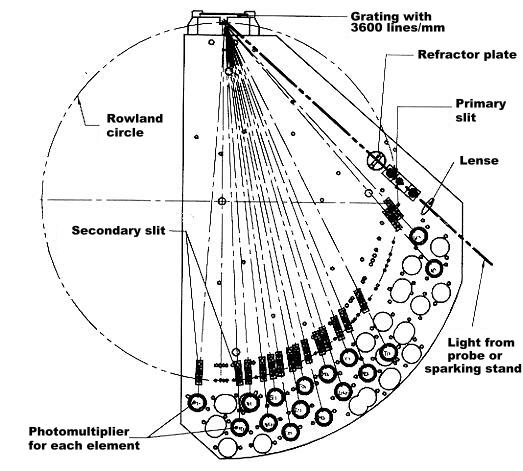
Belec
spectrometer in Paschen-Runge mounting
For
example the Belec spectrometers are spark emission spectrometers for rapid analyses of metals.
An electrical discharge is generated.
The test material is "sparked". Between an electrode
and the test sample, positioned in a sparking stand or a probe, will
generated a discharge via the spark generator.
Thereby the material of the
test sample is converted into a gaseous state. The atoms of
the elements in the material are shifted to a higher state of energy.
On returning to the normal state they
emit the light with the
characteristic wavelengths of the elements.
This light reaches the entrance
of a spectrometer directly (vario lab) or via a fibre
optic (port). There is a narrow entrance
slit (20µm), through which the light falls
on the surface of an optical
grating. This grating is concave
and aluminium plated with 60 (vario lab) or 30 (port) mm Ø diameter and with
3600 groves per millimetre.
Due to the large number of
lines of the grating, the
light is diffracted so much, that it gets
resolved into individual wavelengths. These lines are images of the light
falling through the entrance slit. A nearly linear spectrum
is produced.
The chosen spectral lines for the analysis
of specific elements are directed onto a light sensitive receiver (photo tube) via a 50 micron exit slit. The light which falls
onto the photomultipliertube is directly related to the concentration of that element within the sample.
The pulses generated proportional to the output current
of the photo
tube are counted and a computer calculates and displays the
results in % or ppm on the screen.
All analyses can be stored
continuously and or printed out.